


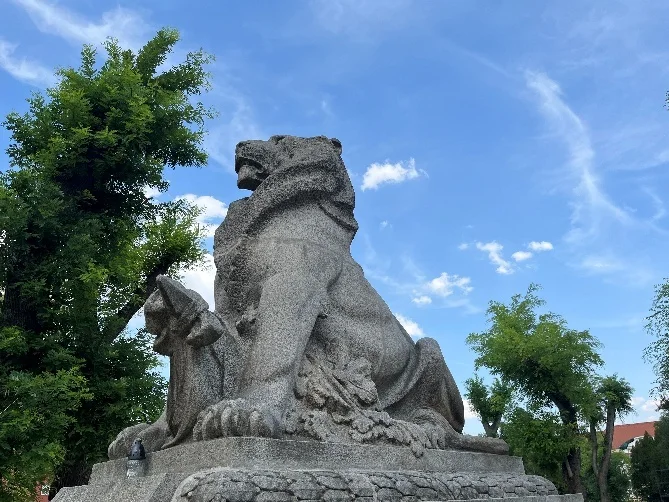
The memorial to the 17th Honvéd Infantry Regiment in Zichy liget, Székesfehérvár, is one of Bory Jenő’s First World War memorial sculptures.
It commemorates the city’s ‘home regiment’, the Royal Hungarian 17th Honvéd Infantry Regiment, which sustained severe losses during the war. The work preserves not only the memory of the fallen, but is also one of the most important symbols of Székesfehérvár’s military traditions.
The officers resolved to erect a heroes’ memorial for the regiment as early as 1915. Plans were made by János Földes Szabó, a sculptor serving with the regiment, and the city provided the site in Zichy liget. Officers, soldiers and townspeople contributed to the cost, and exhibitions and charitable events were held. The first memorial was unveiled in November 1918, directly after the regiment’s return. The work now seen, completed in its final form, was ceremonially unveiled again on 10 June 1928. At the celebration in a flag-decorated city, Royal Prince József spoke and Mayor Aladár Zavaros accepted the memorial for the community of Székesfehérvár.
The central element is a monumental lion guarding the regiment’s flag. The lion symbolises courage, strength, loyalty and military steadfastness. Beneath its paws are a flag and oak leaves, evoking sacrifice and heroic remembrance. The granite lion visible today was made by Bory Jenő to the original concept, respecting Földes Szabó János’s plan. Contemporary sources suggest that the original work was probably simpler, and after the sculptor’s death in 1924 Bory undertook the final version.
The memorial’s rich architectural and sculptural decoration adds to its special value. The base bears the inscription ‘To its fallen heroes, the 17th honvéd infantry regiment of Székesfehérvár, 1914–1918’, while the reverse lists the locations of the regiment’s campaigns and battles. Bronze reliefs on the two sides depict a bayonet charge at Doberdó and close-combat scenes. They were made by István Halmágyi and Antal Havranek to designs by István Philipp.
In art-historical terms the work differs interestingly from several of Bory Jenő’s other First World War creations. While the fighting soldier stands at the centre of the memorials at Mór and ‘69th Forward!’, here the allegorical animal symbol has the leading role. The guarding lion evokes both the regiment’s martial glory and the permanence of the fallen’s memory. The work therefore focuses not on the moment of battle but on the enduring nature of heroic remembrance.
The memorial remains one of the most important sites for military commemorations in Székesfehérvár. The memorial day of the 17th honvéd infantry regiment is traditionally held here each year on 18 July, with military honours for the unit’s fallen. For more than a century, the lion of Zichy liget has thus guarded the memory of the honvéd soldiers of Székesfehérvár.